

Binary options are easy to describe, which is partly why they became popular and partly why they became such a useful product for scammers. A trader takes a yes or no view on a market outcome. Will an asset be above a certain price at expiry? Will an index close below a level? Will a currency pair finish higher than the strike? If the trader is right, the contract pays a fixed amount. If the trader is wrong, the stake is lost.
That structure sounds clean. It is also unforgiving.
Binary options themselves are not automatically scams. In some jurisdictions, binary style contracts can be traded legally through regulated exchanges. Experienced traders may use them as short term speculative instruments, with defined risk and defined reward. The problem is that binary options have also been heavily used by fake brokers, offshore websites, manipulated platforms, aggressive account managers and recovery fraudsters.
The distinction matters. The instrument can be real while the seller is fraudulent. The payout can be simple while the platform is dishonest. The risk can be fixed while the withdrawal process is fake. Traders should not treat the words “binary options” as automatic proof of fraud, but they should treat them as a reason to check harder.
For traders researching the product, broker features and basic terminology, BinaryOptions.net can be used as a starting point for comparing binary options brokers. It should not replace direct verification of regulation, legal access, payment routes and withdrawal rules. Broker comparison is research. It is not due diligence by itself.
Binary option scams work because they make high risk speculation look controlled. The screen is simple. The trade is simple. The outcome is simple. The scam usually sits behind the screen.
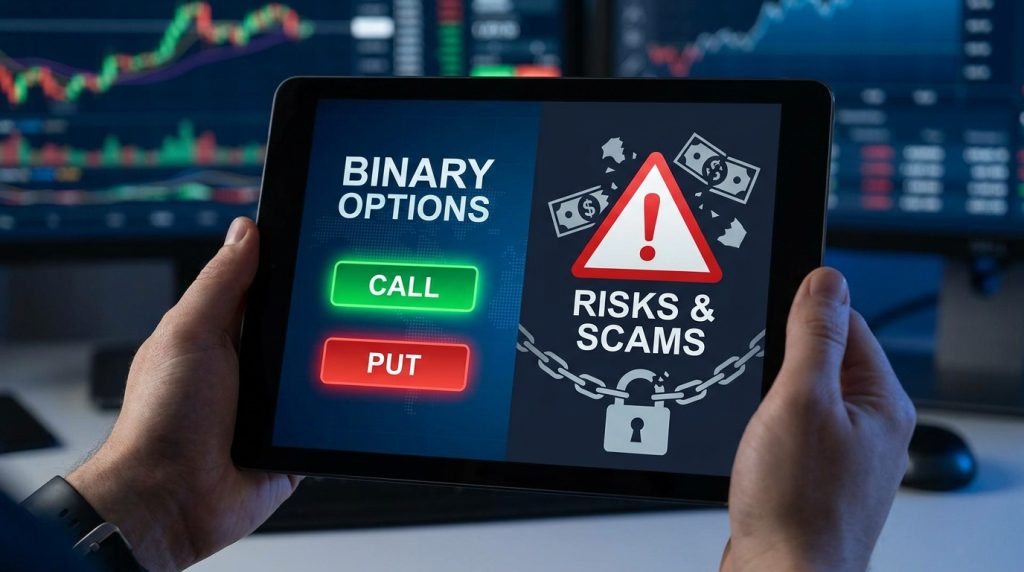
What Binary Option Scams Are
A binary option scam is usually not the mathematical idea of a yes or no payout. It is the deception around that idea. The victim believes they are trading a financial contract, but the platform, broker, pricing, payout, regulation or withdrawal process may be fake.
The simplest version is a fake trading platform. The trader deposits money and sees a dashboard showing binary option trades. The platform displays prices, expiry times, wins, losses and account balances. The trader may think trades are being executed against real markets or through a legitimate venue. In reality, the platform may be controlled entirely by the fraudster. The account balance is just a number on a screen.
The SEC’s binary options fraud guidance explains that binary options involve yes or no propositions and warns that complaints about internet based platforms have included distorted prices, manipulated payouts and account problems. That is the core risk. A trader can understand the product and still be defrauded by the venue.
Another common version is the unauthorised broker. The firm claims to offer binary options legally, but it has no permission to do so in the trader’s jurisdiction. It may claim offshore registration, vague international licensing or approval by a private sounding authority. None of that proves proper financial regulation. Company formation is not the same as permission to offer high risk derivatives to retail clients.
A third version is the managed account scam. The victim is assigned an “expert” who claims to trade binary options on their behalf. The account manager may show strong early profits and encourage larger deposits. The victim is told that bigger accounts receive better signals, higher payouts or protected trades. Once deposits become large, withdrawals become difficult.
A fourth version is the bonus trap. The broker offers a deposit bonus. Later, the trader is told they cannot withdraw until they complete large trading volume requirements. Some bonus terms may be buried in the agreement. Others may be invented when the trader requests money back. Either way, the bonus becomes a lock on the account.
Binary option scams also appear through social media and advertising. The promotion may promise fast profits, low risk, easy signals or beginner friendly trading. That is dangerous. Binary options are easy to place, but not easy to trade profitably. The trader must be correct about direction, timing and expiry. Short duration contracts can depend on market noise rather than a useful trading edge.
The product’s simplicity is the sales hook. The platform’s honesty is the real question.
Why Binary Options Are Used In Scams
Binary options are useful to scammers because the pitch is short. A fake broker does not need to explain earnings, bond covenants, portfolio theory, credit risk or option Greeks. It can say: choose up or down, risk a fixed amount, receive a fixed payout. That is enough to make the product look accessible.
The fixed payout also creates a false sense of control. The trader knows the maximum loss before entering. That can be useful in a legitimate setting, but it does not make the trade favourable. If a trader risks $100 to make $80, the trader must win more than half the time to break even. A losing trade usually loses the full stake, while a winning trade may pay less than the stake at risk.
This payout arithmetic is often ignored in scam marketing. A platform advertises 70 percent, 80 percent or 90 percent payouts, and beginners may interpret those numbers as attractive returns. They may not calculate the required win rate. They may not account for trade frequency, slippage, pricing, expiry risk or emotional errors. The product looks cleaner than it is.
The CFTC and SEC investor alert on binary options and fraud says complaints about fraudulent binary options platforms have included refusal to credit accounts, denial of fund reimbursement, identity theft and software manipulation to generate losing trades. That warning explains why the product developed such a poor reputation. The risk was not only bad trading. It was bad actors controlling the trading environment.
Short expiries add to the problem. Many binary option offers focus on very short time frames, sometimes minutes or less. That makes trading feel fast and exciting. It also makes the outcome more sensitive to random price movement, spread changes, platform timing and small distortions in the displayed quote. A trader can have a reasonable market view and still lose because the expiry window is poorly chosen.
Scammers also like binary options because losses can be explained away. If the trader loses, the broker says the market moved. If the platform blocks withdrawals, it says compliance is reviewing the account. If profits vanish, it cites pricing rules. If the trader questions results, support says the expiry price was calculated correctly. Some of these issues can happen at legitimate venues, but a regulated firm has clearer rules and complaint processes. A scam platform has excuses.
Affiliate marketing played a large role in spreading poor quality binary options platforms. Search results, review sites, email campaigns and social media accounts pushed users toward brokers in return for commissions. Some material was educational. Some was marketing with a moustache and a fake badge. Traders searching for “best binary options broker” could easily land in a funnel designed to generate deposits.
Binary options are not uniquely dangerous because of one feature. They are dangerous in scams because the product is simple, fast, high risk, easy to market and easy for a dishonest platform to control.
Fake Brokers And Manipulated Platforms
Fake binary options brokers often look professional enough to pass a quick inspection. The website may show market prices, asset lists, trading tools, customer support, account tiers and educational material. The platform may display charts and trade history. The problem is that none of these features prove that the firm is authorised, that client funds are protected, or that trades are being handled fairly.
A fake platform can copy real market prices from public feeds. The trader sees familiar movements in currencies, commodities, indices, stocks or crypto assets. That creates confidence. But a price display is not the same as execution. A scam platform can show real market movement while still fabricating trade outcomes.
Binary options are particularly exposed to platform manipulation because results can turn on tiny differences. If a contract pays only when an asset closes above a level at expiry, a one tick difference can decide the trade. A dishonest platform may distort prices, delay execution, reject profitable trades, change expiry calculations or show a price source the trader cannot verify.
The CFTC warning about off exchange binary options says complaints have included platforms denying requests to return funds, requiring hidden fees to return assets, overstating returns and manipulating charts to make investing look more promising. That is exactly why traders should be cautious with platforms outside regulated exchanges.
Account managers are another common feature. After the trader deposits, a representative calls to provide “support.” The support quickly becomes sales pressure. The manager may say the trader is missing strong signals, should upgrade to a higher tier, or needs a larger balance to access better trades. The language sounds like service. The purpose is extraction.
Small early withdrawals can also be part of the scam. A trader deposits a small amount, makes a profit, and successfully withdraws part of it. This builds trust. The trader then deposits more. When the larger withdrawal is requested, the platform becomes difficult. That first withdrawal was not proof. It was bait.
Fake brokers also use copied identities. They may claim to be connected to a known financial firm, use a similar name, display a licence number from another company, or show a regulator logo without permission. The trader should not trust any licence claim shown on the broker website. The firm must be checked through the regulator’s own register, using the exact legal entity, website, phone number and email address.
The FBI warned investors to be careful with binary options websites and said due diligence is needed before placing the first trade in its binary options fraud warning. That advice remains relevant because fake platforms often target people before they know what questions to ask.
The safest assumption is that a binary options platform is untrusted until verified. The broker should prove its status through official records, clear rules, reliable withdrawals and transparent pricing. A slick interface is not enough. A slick interface is what scammers buy first.
Withdrawal Traps And Identity Theft
Many binary option scams become obvious when the trader tries to withdraw funds. Until then, the platform may look active. The account may show profit. Support may respond quickly. The account manager may stay friendly. Withdrawal changes the tone.
The trader requests money back and is told that something must be completed first. A tax payment. Compliance clearance. Broker commission. Anti money laundering release. Account upgrade. Liquidity fee. Bank transfer charge. Identity verification payment. The fee must be paid separately before the withdrawal is processed. After that, another issue appears.
This is one of the clearest scam patterns. Real financial firms can charge fees, request identity documents and review withdrawals. But a firm demanding fresh deposits before releasing existing funds should be treated as high risk. If a fee is legitimate, the obvious question is why it cannot be deducted from the account balance.
The answer, in many scams, is that the account balance is not real. It is a number designed to keep the victim paying. The larger the displayed balance, the more tempting it becomes to pay a smaller fee to unlock it. This is how victims can lose additional money after the first deposit.
Identity theft is another risk. Binary options platforms often request know your customer documents, including passports, driving licences, proof of address, bank card images and payment details. Regulated firms need identity checks, so document requests are not automatically suspicious. Fake platforms collect the same information and may misuse it. The victim can lose money and then face fraud using their personal details.
The CFTC and SEC investor alert mentioned earlier identifies identity theft as one of the complaint categories associated with fraudulent binary options platforms. That should make traders cautious about uploading documents before verifying the firm. Sensitive documents should not be sent to a platform just because its website looks tidy.
Recovery scams often follow withdrawal traps. After the victim loses money, someone claims they can recover it. They may pose as a lawyer, regulator, enforcement agent, blockchain analyst, chargeback expert or financial investigator. The pitch is that funds have been traced, but a fee is required to release them.
This is usually the second scam. The victim is tired, angry and embarrassed. They want the loss reversed. The recovery fraudster sells hope. A legitimate recovery route may exist through banks, card providers, law enforcement or legal channels, but guaranteed recovery for an upfront fee is a serious warning sign.
A victim should not send more money because a platform or recovery agent says one final payment will solve everything. In these scams, “final payment” is often a reusable phrase.
Regulation In The UK, EU And US
Binary options regulation depends heavily on jurisdiction. A platform accepting deposits does not mean the product is legal where the trader lives. Scammers are famously relaxed about that distinction.
In the United States, binary options can be traded legally on registered exchanges, but many online platforms operate outside the law. The CFTC binary options fraud page states that binary options can be traded on registered U.S. exchanges and warns that much of the binary options market operates through internet based platforms that may not comply with regulatory requirements. For U.S. traders, the venue is central.
The CFTC has also said that not all binary options trading is fraudulent and that binary options can be legally traded on regulated U.S. exchanges in its 2018 announcement on binary options fraud education. This is the cleanest way to frame the issue. The instrument is not automatically fake. The problem is the large number of fraudulent or illegal venues.
In the UK, retail binary options are effectively banned. The FCA confirmed a permanent ban on the sale of binary options to retail consumers, with the ban applying to firms acting in or from the UK. The FCA described binary options as products that had caused consumer harm and were often associated with fraud.
The FCA’s policy statement on retail binary options confirmed final rules prohibiting the sale, marketing and distribution of binary options to retail consumers. UK traders should treat any offer of retail binary options as a serious warning, especially if it comes from an offshore platform or social media contact.
In the European Union, ESMA introduced product intervention measures restricting binary options for retail clients. ESMA’s notice on the renewal of its binary options prohibition stated that the marketing, distribution or sale of binary options to retail clients had been prohibited since July 2018 under temporary measures. Some national regulators then adopted their own rules after the temporary ESMA measures expired.
The regulatory history matters because it shows the scale of concern. Regulators did not focus on binary options because the name sounded unfashionable. They acted because complaints, losses, misleading sales and platform fraud became common enough to justify strong intervention.
For traders, the practical order is clear. First, check whether binary options are legal for retail clients in your country. Second, check whether the venue is authorised. Third, check the payout, pricing, expiry and withdrawal rules. If the first answer is no, the rest is not worth polishing.
Red Flags Before Depositing Money
A guaranteed return is the first warning. Binary options are speculative. No broker, signal provider, account manager or mentor can guarantee profits from short term price outcomes. A claim of fixed daily or weekly income should end the conversation.
A high win rate without verified records is another warning. Screenshots are not proof. A proper record should show all trades, losing periods, stakes, payouts, expiry times, total drawdown and account history. A few green trades prove very little.
Pressure to deposit quickly is a major problem. Scammers use short expiry language, bonus deadlines and account tiers to rush the trader. A genuine decision about a high risk product should not be made because someone on the phone says the signal is live.
Vague regulation should stop the process. A broker should provide the exact legal entity, regulator, licence number and authorised activities. These details should be checked through the regulator’s official website, not through links supplied by the broker.
Strange payment routes are another red flag. Funds going to personal accounts, unrelated companies, crypto wallets, payment apps or gift cards should be treated as high risk. A legitimate platform should have a clear payment process tied to the legal entity or a recognised payment provider.
Withdrawal fees requiring fresh deposits are one of the strongest scam signals. Tax fee, release fee, compliance fee, broker commission, wallet validation, liquidity fee; the label changes, but the structure is the same. The trader must pay more to access money already shown on screen.
Remote access requests should be rejected. No broker or account manager should need to control a trader’s computer or phone to open an account, place trades or process withdrawals. Remote access can expose bank accounts, emails, passwords, identity documents and crypto wallets.
Bonus terms need careful reading. A deposit bonus can block withdrawals through turnover requirements. A trader should understand those terms before accepting any credit.
Finally, contempt for questions is a warning. If the salesperson becomes annoyed when asked about regulation, pricing, withdrawal terms or payment routes, they have provided an answer without meaning to.
How Experienced Traders Reduce Risk
Experienced traders begin with jurisdiction. Is the product legal for retail clients where they live? If not, they stop. Using an offshore platform to bypass local restrictions is not clever. It usually means giving up protections before the first trade.
The second check is the venue. The trader should identify the exact legal entity and search the relevant regulator’s official register. The firm name, website, phone number, email, address and permissions must match. Similar is not enough.
The third check is the payout structure. A trader should calculate the break even win rate before entering a strategy. If the payout is 80 percent on a win and 100 percent loss on a losing trade, the trader needs to win above 55 percent before costs to break even. Without an edge, the product’s simplicity just makes losses arrive faster.
The fourth check is expiry selection. Very short expiries can make trading dependent on noise. Experienced traders match the expiry to the trade thesis and avoid treating binary options like arcade buttons. The market does not award points for speed.
The fifth check is pricing. The trader should understand the price source, settlement method and expiry calculation. If the platform cannot explain how outcomes are determined, it should not be trusted.
The sixth check is funding and withdrawal. The payment recipient should match the legal entity or a clearly disclosed provider. Withdrawal terms should be clear before deposit. Traders should be wary of bonuses, hidden fees and account tier restrictions.
The seventh check is position size. Binary options can expire worthless, so risk per trade should be small. Losing streaks are normal. A trader who risks too much per contract can destroy the account even without fraud.
The final check is records. Keep deposit receipts, trade confirmations, platform screenshots, chat logs, emails and withdrawal requests. If a dispute happens, records matter more than memory.
What To Do After Suspected Fraud
Stop sending money immediately. Do not pay release fees, tax charges, wallet activation costs, compliance fees, account upgrades or recovery fees. A scammer asking for one more payment is usually not resolving the issue. They are extending the loss.
Save evidence quickly. Capture the platform dashboard, balances, trade history, expiry results, emails, chat messages, phone numbers, names, payment instructions, wallet addresses, transaction IDs and identity documents sent. Export chat logs where possible.
Contact the bank, card provider, payment service or crypto exchange used. Ask whether payments can be stopped, recalled, disputed, frozen or flagged. Card payments may offer dispute routes. Bank transfers and crypto transfers can be harder, but speed still helps.
Report the fraud. U.S. victims can report internet enabled fraud through the FBI Internet Crime Complaint Center, securities concerns through the SEC complaint process, and consumer fraud through the FTC fraud reporting portal. UK victims can report suspicious financial firms through the FCA scam reporting page and fraud through Report Fraud.
Be careful with recovery offers. Anyone promising guaranteed recovery for an upfront fee may be running the next scam. A legitimate recovery route does not require seed phrases, remote access or secrecy from authorities.