

Broker scams are among the most damaging types of financial fraud because they copy something traders already expect to use. A trader needs a broker. A trader expects a platform, spreads, margin, charts, account funding, identity checks and support. A scammer only has to build something that looks close enough.
That is why broker scams can catch people who are not completely new to markets. The victim may understand candlesticks, earnings, forex pairs, crypto wallets, CFDs, options or leverage. They may still lose money because the firm holding the account is fake, cloned, unauthorised, offshore without meaningful protection, or designed to block withdrawals once deposits are large enough.
The basic risk is not just poor trading. A bad trade can happen at a legitimate broker. A scam broker is different. It may lie about regulation, copy a real company’s identity, manipulate the platform, fabricate balances, pressure deposits, refuse withdrawals or demand extra payments before releasing funds.
Daytrading.com online trading and broker research resource can help traders compare market access and trading topics, but broker choice should always be verified separately through official registers and regulator sources. A broker’s website, reviews and platform screenshots are not enough.
Broker scams work because they make fraud look like normal account opening. The trader deposits funds, sees a dashboard and believes the trading relationship has begun. In reality, the money may already be gone. The account balance may only be a number on a screen.
The safest habit is simple: do not fund a broker until the legal entity, regulator, website, contact details, payment route and withdrawal terms have been checked independently.
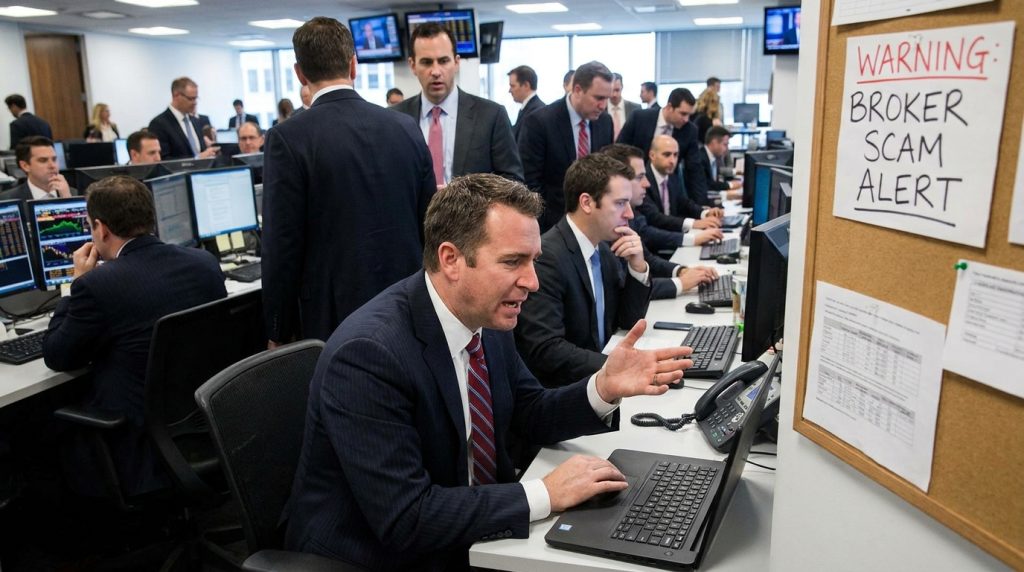
How Broker Scams Work
Most broker scams begin by creating confidence. The scammer needs the target to believe there is a real trading account, a real firm, and a real route for withdrawals. The platform does not have to survive expert scrutiny. It only has to survive the victim’s first few checks.
Some scams start through online adverts. Others begin with a social media post, WhatsApp message, cold call, fake comparison site, trading education funnel, dating app conversation, or direct message from someone claiming to be an analyst. The route changes, but the goal is the same: move the victim toward a deposit.
Once the account is opened, the broker may show early profits. This is common. The trader deposits a small amount, places trades or watches trades placed by an account manager, and sees the balance grow. The platform may even allow a small withdrawal. That first withdrawal can be bait. It proves enough to encourage larger deposits later.
The SEC guidance on avoiding investment fraud warns that fraudsters rely on people not investigating before they invest and that asking the seller for more information is not enough. That applies directly to fake brokers. A scam broker can provide documents, account statements, certificates and confident explanations. Independent checking is the part they cannot control as easily.
Broker scams often use account managers. The manager calls or messages regularly, gives market commentary, explains trades and encourages larger funding. They may say the account qualifies for a premium tier, higher leverage, stronger signals, managed trading or protected returns. The tone is often professional, but the purpose is sales pressure.
A real broker may provide support. A scam broker creates dependency. The victim is encouraged to rely on the account manager for deposits, trades, bonuses, upgrades and withdrawals. The more personal the relationship feels, the easier it becomes to ask for more money.
The FINRA guidance on avoiding fraud gives investors resources for spotting investment fraud and reporting suspicious conduct. One recurring lesson is that trust should not be built only on the person making the pitch. Broker fraud often depends on that false trust.
The worst part is that scam broker losses do not always look like theft at first. A trader may think they are losing because of volatility, margin, bad signals or poor timing. Sometimes that is true. But when deposits keep being requested, withdrawals fail, support becomes evasive and fees appear from nowhere, the problem is no longer market risk. It is counterparty risk with a fake smile.
Clone Brokers And Fake Authorisation
Clone broker scams are especially dangerous because they borrow credibility from real regulated firms. A scammer copies the name, licence number, logo, address or website style of a legitimate broker or investment company. The victim searches the name, finds a real firm on a regulator’s register, and assumes everything is safe.
That assumption is exactly what the scammer wants.
The correct check is not only whether the firm exists. It is whether the person contacting you, the website you are using, the email address, phone number, payment account and legal entity all match the official details. A clone firm often fails only when those details are compared carefully.
A dedicated guide to broker clone scam warning signs explains how fraudsters impersonate legitimate brokers and use copied information to make fake platforms look credible. This is one of the most common traps in online trading because the victim may think they have already checked regulation when they have only checked a copied name.
The FCA’s Warning List of unauthorised firms tells consumers to be cautious of scammers pretending to be authorised firms and says clone firms may copy genuine firms. It also advises using official contact details from the regulator’s Firm Checker rather than details supplied by the person making contact.
That point deserves attention. If a person phones, emails or messages you claiming to represent a regulated broker, do not reply through the details they provide. Go to the regulator register or the firm’s official site independently. Use the official number or email. Scammers know that victims often call the number in the email. That number may lead straight back to the scam operation.
The FCA has previously warned about clone firm investment scams and reported that clone scam reports rose sharply during the early pandemic period, with fraudsters using real firm details to mislead investors through its clone firm scam warning. Clone scams remain effective because they exploit a sensible behaviour: checking regulation. The scammer simply makes the first result misleading.
In the U.S., traders can use FINRA BrokerCheck to research brokers and brokerage firms. This is useful, but again the details must match. A scammer may point to a legitimate registered person while communicating through an unofficial email, personal messaging app or unrelated payment route.
Fake authorisation language is also common. A broker may claim to be “globally licensed,” “internationally regulated,” “registered with financial authorities,” or “approved for professional trading.” These phrases are weak unless they lead to a real regulator entry for the exact legal entity offering the account.
Company registration is not the same as broker regulation. A company can be incorporated in a country without being authorised to provide trading services, hold client money, offer CFDs, provide investment advice or serve retail clients. Scammers love this confusion because a company number looks official enough to calm people down.
A clone broker can look better than a weak real broker because it has stolen the identity of a strong one. That is the trick. The victim is not judging the scammer’s credibility. They are judging the real firm’s credibility, then handing money to someone else.
Fake Platforms, Manipulated Accounts And Withdrawal Traps
Fake trading platforms are built around the same illusion: the account looks real until money needs to leave. The platform may show live charts, asset lists, order tickets, profit and loss, account history, market news and customer support. Some fake platforms are basic. Others are polished enough to fool experienced users who are moving quickly.
The central problem is that the dashboard does not prove custody. A balance on screen is not the same as money held in a regulated client account. A trade shown on a platform is not proof that an order was sent to a real market. A profit number is not proof that profit exists.
Fake platforms may copy market prices from real feeds. That makes them feel legitimate. The trader sees EUR/USD, gold, oil, indices, crypto or stocks moving in line with public markets. But the platform can still be fake. Displaying prices is easy. Operating a regulated brokerage is not.
Manipulation can happen in several ways. Trades may be delayed. Winning positions may be rejected or closed strangely. Stop losses may trigger at odd prices. Account history may change. Profits may disappear. Withdrawal requests may be ignored. Some of this can also happen through technical issues at legitimate brokers, but regulated firms have complaint processes, records and oversight. Scam platforms have excuses.
The CFTC warning on forex fraud tells consumers to be wary of online tips, testimonials and recommendations, and warns against trading with dealers that only accept crypto assets. This is relevant because many fake broker platforms operate in forex, CFDs and crypto pairs. They use real market names but unsafe funding routes.
Withdrawal traps are the most common sign. The trader requests money back and is told that a tax fee, anti money laundering charge, account upgrade, liquidity release, settlement fee, wallet verification or margin repair payment is required. These charges must be paid separately before funds can be released.
A real broker can have withdrawal checks. It can ask for identity documents. It can delay a payment under compliance rules. But a broker that repeatedly demands fresh deposits before releasing existing funds is following a well known scam pattern. A legitimate fee can usually be deducted from the balance under the firm’s terms. A fake fee needs new money because the balance is imaginary.
Bonuses are another withdrawal trap. The broker offers deposit credit, then later says withdrawals are blocked until the trader completes a large turnover requirement. Bonus terms can be restrictive even at real firms, but scam brokers use them as a weapon. The trader thinks the bonus is free money. It becomes a lock on the account.
Account managers often make the withdrawal trap worse. They may say the withdrawal is nearly complete, but the trader must act quickly. They may blame the compliance department, payment processor, bank, tax authority, exchange or liquidity provider. The story changes, but the request remains the same: send more money.
The trader should not confuse a larger displayed balance with a better chance of recovery. Scam platforms deliberately show large balances because the victim is then more willing to pay smaller fees to unlock them. That is not recovery. That is the final squeeze.
Social Media Broker Scams And Signal Funnels
Broker scams often start outside broker websites. Social media, messaging apps and trading groups are now common entry points. A trader sees a video, post, advert or comment about easy profits, private signals, AI trading, funded accounts, forex mentorship or crypto trading. The content pushes them toward a broker link or private group.
The public content may look educational. The private funnel is where the money is made. A Telegram or WhatsApp group posts signals and screenshots. Members appear to be winning. The group recommends a broker, often with a special link. The trader deposits and follows the signals. Losses, blocked withdrawals or extra fees come later.
The SEC investor alert on social media and investment fraud warns that fraudsters use social media to impersonate sources, spread false information and lure investors into schemes. Broker scams fit this pattern because the pitch often starts with content and ends with a deposit.
Signal sellers can also be part of the problem. Some are merely poor traders. Some are affiliate marketers. Some are connected to unsafe brokers. A signal group may claim high win rates but show no verified record. It may delete losing trades, post entries after the move, or encourage heavy leverage. The broker may profit from trading volume even when the trader loses.
Copy trading can be legitimate through regulated platforms, but scam brokers use it as a passive income pitch. The victim is told they can copy an expert and avoid learning the market. The platform shows steady gains. The account manager encourages larger deposits. Withdrawal fails.
Social proof is weak evidence. Comments, likes, testimonials and screenshots can be bought or staged. A group full of people claiming they withdrew money does not prove that you will. A video of a trader withdrawing funds does not prove the broker is safe. One successful withdrawal can be bait.
Traders should separate education from account funding. A video can explain a chart pattern. It cannot verify a broker. A signal group can discuss trades. It cannot prove regulation. A creator can have followers. That does not make their broker link safe.
Forex, Crypto And Offshore Broker Fraud
Forex and crypto are frequent targets for broker scams because they are popular, volatile and easy to fund online. Again, the markets themselves are not scams. Forex is a real global market. Crypto assets are real digital instruments, although speculative and unevenly regulated. The problem is the fake or unsafe broker sitting between the trader and the market.
Retail forex fraud often uses high leverage, guaranteed signals, managed accounts or automated bots. The victim is told that an expert will trade on their behalf or that software can produce steady returns. The platform shows growth, then requires larger deposits. If losses appear, they are blamed on market volatility. If profits appear, withdrawal is blocked by fees.
Crypto broker scams often use fake exchanges or hybrid trading platforms. The trader deposits Bitcoin, Ethereum, stablecoins or other assets. The platform displays profits from forex, crypto pairs, options or mining products. Withdrawal then requires wallet validation, gas fees, tax payments or liquidity release. These terms sound technical enough to slow down doubt.
The FBI guidance on cryptocurrency investment fraud describes scams where victims are persuaded to send funds into fake investment platforms controlled by criminals. The victim may see profits on screen while the funds are already under criminal control.
Offshore regulation is another issue. Some offshore brokers are real businesses, but protections vary sharply by jurisdiction. A broker may be incorporated somewhere without offering strong client money rules, compensation schemes, leverage limits, dispute resolution or local enforcement. A scammer may also use offshore language simply to confuse the customer.
The payment method is a major clue. A broker that accepts only crypto, payment apps, or transfers to unrelated companies is high risk. A regulated broker should have clear funding instructions tied to the legal entity or an authorised payment processor.
Traders should be careful with any broker that avoids direct questions about jurisdiction, regulator, client funds, execution, withdrawal rules and complaints. A firm that cannot answer these points in writing should not receive capital.
Recovery Scams After Broker Fraud
Broker fraud often leads to a second scam: recovery fraud. The victim loses money to a fake broker, then later receives contact from someone claiming to recover lost funds. The person may say they are a lawyer, regulator, bank official, blockchain analyst, enforcement agent or private investigator.
The pitch is cruel but effective. The victim wants the loss reversed. The recovery agent says the funds have been traced or frozen, but a fee is needed to release them. The fee may be called a tax, bond, legal charge, wallet activation, court filing, insurance or compliance payment. Once paid, another fee appears.
A practical guide to fund recovery scam tactics explains how victims can be targeted again after losing money to a fraudulent broker or investment platform. This second stage often works because the victim is emotionally exhausted and still hoping the first loss can be undone.
Real recovery can sometimes happen through banks, card disputes, exchanges, law enforcement, insolvency processes or regulated legal channels. But guaranteed recovery for an upfront fee is a major warning. Anyone asking for seed phrases, wallet access, remote access software, secrecy from authorities or more payments to unlock funds should be treated as a fresh scammer.
Victims should also be careful when searching online for recovery help. Some recovery scam sites are designed to appear in search results for fake broker names. They may claim to have helped other victims of the same broker. That may be another lure.
The safest recovery route starts with official channels: bank, payment provider, regulator, police or recognised dispute process. It does not start with a stranger in a chat promising to retrieve money for a fee.
Red Flags Before Opening An Account
A broker promising guaranteed returns is a red flag. Brokers provide market access. They do not guarantee trading profits. If an account manager promises fixed weekly income, high win rates or no loss trading, the pitch is already broken.
Unclear regulation is another warning. The broker should name the legal entity, regulator, licence number and authorised activities. Vague claims such as “globally regulated” or “internationally licensed” are not enough.
Mismatched contact details matter. If the website, email or phone number differs from the regulator’s official record, stop. Clone brokers rely on small differences being ignored.
Strange payment instructions are a major warning. Funds should not go to personal bank accounts, unrelated companies, unknown wallets, gift cards or payment apps. The payment recipient should match the firm or a clearly disclosed payment processor.
Pressure to deposit quickly is also suspicious. A broker may offer promotions, but it should not pressure traders to fund immediately, borrow money, use credit cards, or increase deposits after losses.
Bonus traps deserve caution. A deposit bonus may block withdrawals until large turnover conditions are met. Read terms before accepting anything. Free credit is rarely free in trading.
Withdrawal fees requiring new deposits are a strong scam signal. Tax, release, compliance or liquidity fees that cannot be deducted from the account balance should be treated as suspicious.
Remote access requests should be rejected. No broker needs full control of a customer’s computer or phone to open an account, deposit, trade or withdraw.
Unverified testimonials are weak evidence. Reviews, screenshots and influencer videos can be staged. A broker should be judged by regulation, terms, payment structure and withdrawal history, not hype.
The final warning is evasive support. If simple questions about regulation, custody, fees or withdrawals are pushed to phone calls or answered vaguely, the firm is giving useful information by avoiding useful information.
Due Diligence Before Depositing Funds
Start with the legal entity. The brand name is not enough. Find the company name in the account agreement and terms. Then search that exact entity on the relevant regulator’s register.
Compare official details. The website, phone number, email, address and permissions must match. A single mismatch can matter. Clone brokers are built from near matches.
Check product permission. A firm may be authorised for one activity but not another. It may be allowed to provide investment advice but not CFDs, or payment services but not brokerage. The exact permission matters.
Read the withdrawal policy before depositing. Look for fees, processing times, identity requirements, bonus restrictions, dormant account charges and account tier rules. The ability to withdraw is more important than a tight spread.
Check the payment recipient. The beneficiary should match the broker’s legal entity or a clearly disclosed payment processor. If payment goes elsewhere, ask why and verify the answer independently.
Search for regulator warnings and repeated complaint patterns. Reviews are imperfect, but repeated blocked withdrawal complaints, pressure calls, changed domains and surprise fees should not be ignored.
Ask written questions. A legitimate broker should answer clearly in writing or direct you to formal documents. Avoid relying on verbal claims from account managers.
Use small exposure only after verification, and do not treat a small successful withdrawal as full proof. Some scam brokers allow early withdrawals to build trust. Verification matters more than bait performance.
What To Do After Suspected Broker Fraud
Stop sending money immediately. Do not pay tax fees, release fees, upgrade charges, wallet validation fees or recovery charges. More payments usually deepen the loss.
Save evidence. Take screenshots of the broker website, account dashboard, trade history, balances, messages, emails, phone numbers, payment instructions, wallet addresses and transaction records. Export chat logs where possible.
Contact your bank, card provider, crypto exchange or payment service quickly. Ask whether the payment can be stopped, recalled, disputed, frozen or flagged. Timing matters.
Report the fraud. U.S. victims can report internet enabled scams through the FBI Internet Crime Complaint Center, securities concerns through the SEC complaint process, and broker related concerns through FINRA’s complaint process. UK victims can report suspicious firms through the FCA scam reporting page and fraud through Report Fraud.
Tell someone trusted. Broker scams isolate victims and use embarrassment to keep payments flowing. A second person can help stop further damage and spot recovery scams.